
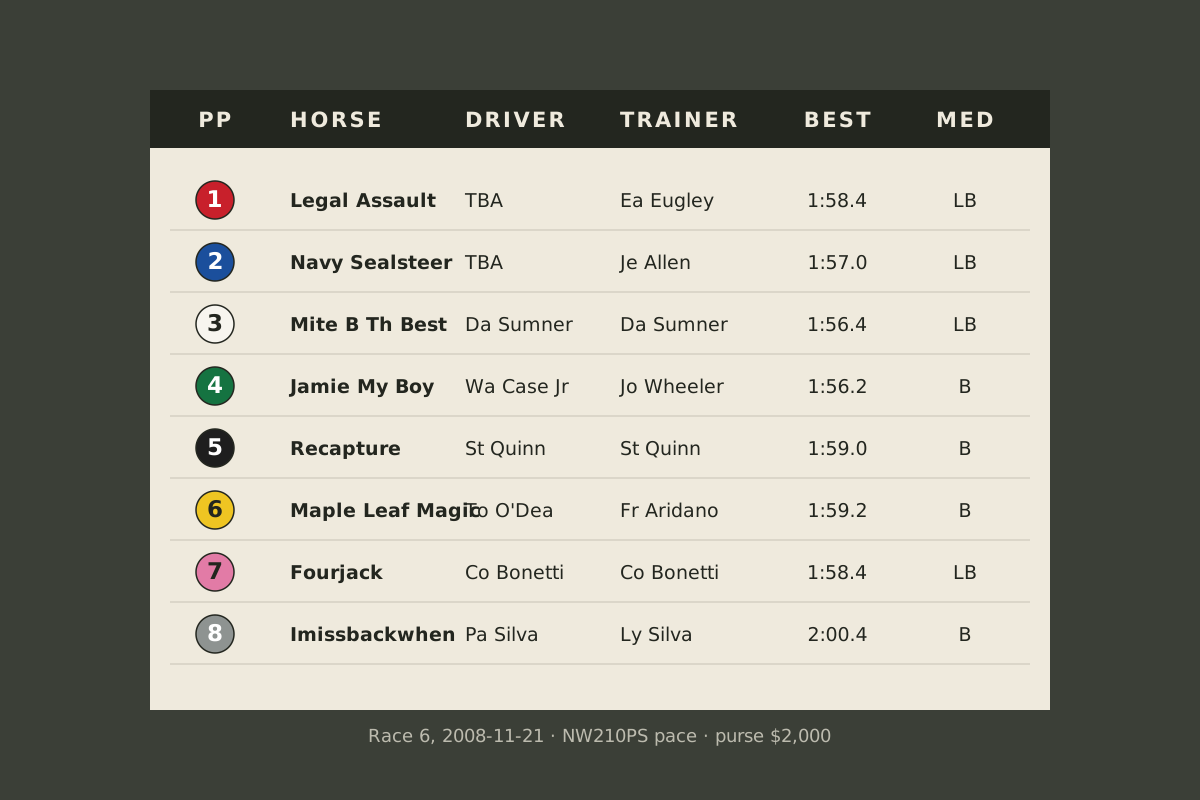
The Sheet
Harness racing entries were the first of two documents the racing office produced for every afternoon of racing. They went out days ahead so that owners and bettors knew the field, and the official chart followed after the race to record what happened. This section is about that first document.
A harness racing race card is short but dense, and none of it is labelled for outsiders. A horseman scans it in a fixed order: post position first, then class, then who is driving, then the seasonal best mile, and last the medication column. Everything else on the sheet is detail.
What a Harness Racing Entries Sheet Carries
The PP column on a harness racing race card gives the slot each horse drew, counted outward from the rail. It matters more here than in most codes, because the field leaves behind a moving gate in a set line and the first turn arrives quickly. An outside draw can cost the race early.
Each position also carries a standard colour on the saddle pad, which is why they appear here as coloured chips rather than plain digits. Post one is red, two blue, three white, four green, five black, six yellow, seven pink and eight grey. The system exists so spectators can follow a horse at distance.
The draw is not a formality here, and the surviving record proves as much. Over 3,455 charted starts at this track, post 3 produced a winner 16% of the time while post 8 managed only 3% of the time. That is the single most useful figure on the whole sheet.
Post Position First on the Race Card
Above the field sits the condition: gait, purse, distance and a class code such as NW200PS or 3000CL. That code is the eligibility rule written in shorthand, and it sets the real class of the race far better than the purse does. The condition glossary decodes every code that appears in these programs.
Driver and trainer are named separately for each horse. At a regional meeting the same person very often fills both roles, so repeated names down a card are entirely normal rather than a printing error. Those repeated pairings are usually the single most useful signal on the whole sheet when judging form.
Class, Driver and Trainer in the Program
The best column shows the quickest mile the horse had gone that season, in minutes, seconds and fifths. It resets each January, so a blank means unraced rather than slow. Post time sits at the head of the sheet, and harness racing entries close days before that post time arrives.
| Letter | Declared medication |
|---|---|
| L | Lasix (furosemide), declared before the race |
| B | Bute (phenylbutazone), declared before the race |
| LB | both Lasix and Bute declared for this start |
What the Columns Add Up To
Read across 8,095 entries rather than down one sheet and the columns start to describe the meeting itself. A claiming price is posted beside 5,382 of them, 66% of the whole, which places this firmly as a claiming track: most horses racing here were available to be bought at a stated figure straight after the race.
The medication column is filled on 5,341 lines. Lasix appears on 3,634 of them and phenylbutazone on 2,729, with 1,022 carrying both. The letters are a declaration made before the race, not a finding afterwards, and a blank means nothing was declared rather than that nothing was given.
330 lines name no driver at all and read TBA. That is the sheet doing its job: entries closed days before the card, and the drive was still open when the programme went to print. Those lines are kept exactly as printed here, because a name invented for them would be the one thing on the page that never happened.
Seasonal Best, Medication and Post Time
The most recent surviving harness racing entries are listed below, each with its post time card intact. A page marked as an entry sheet means the chart did not survive; one marked as charted holds the result too, and the two together show how a field as drawn turned into a finish.
entry sheet only → Sep 27, 2014 8 races
entry sheet only → Jul 9, 2014 12 races
entry sheet only → Jul 16, 2013 9 races
entry sheet only → Jul 15, 2013 9 races
entry sheet only → Jul 11, 2013 8 races
entry sheet only → Jul 4, 2013 8 races
entry sheet only → Jul 2, 2013 10 races
entry sheet only → Jun 6, 2013 9 races
entry sheet only → May 28, 2013 13 races
entry sheet only →
Questions About Entries
What is a harness racing entry sheet?
It is the field for a card as drawn, published days before the race. It gives each horse a post position, names the driver and trainer engaged, shows the best mile the horse has recorded that season and lists any declared medication. It is a forecast rather than a result.
How is it different from the official chart?
The chart is written after the race and records what happened: running position at each quarter, margin at the wire, individual time and closing odds. The entry sheet says who was supposed to race and from which post; the chart says who actually won, by how far, and in what time.
What does the PP column mean?
Post position — the starting slot the horse drew, counted from the inside rail outward. On a five-eighths-mile oval the inside posts carry a genuine advantage into the first turn, which is why that number is the very first thing most horsemen look at on the sheet.
Why are post positions shown as coloured numbers here?
Because that is how they appear at the track. Harness racing assigns a standard saddle-pad colour to each post position, so post one is red, two blue, three white, four green and so on down the field. The colour lets a spectator follow a horse round the far turn without needing to read numbers.
What is the "best" column?
The fastest mile that horse had recorded in the current season at the time the sheet was printed. It is a rough class indicator rather than a prediction, and it resets every January, so a lightly raced horse early in a season may show no figure there at all rather than a slow one.
What do the letters in the medication column mean?
They are declared medications, filed before the race rather than found afterwards. L is Lasix, B is Bute, and LB means both were declared. They are printed in the program so that anyone studying the field can weigh them up next to the rest of the form.
What is a claiming price doing in an entry sheet?
In a claiming race every starter is for sale at a stated figure, and any eligible owner can buy one shortly after the race. The price is printed for each horse individually, because a claiming field can be assembled from several different price levels with weight or purse allowances applied.
How many entry sheets survive here?
Entry sheets survive for 181 of the 241 race days in this archive, covering 8,095 individual entries in total. Where both the sheet and the official chart survive for one date, the race day page shows the chart and keeps the sheet's context alongside it rather than discarding either document.